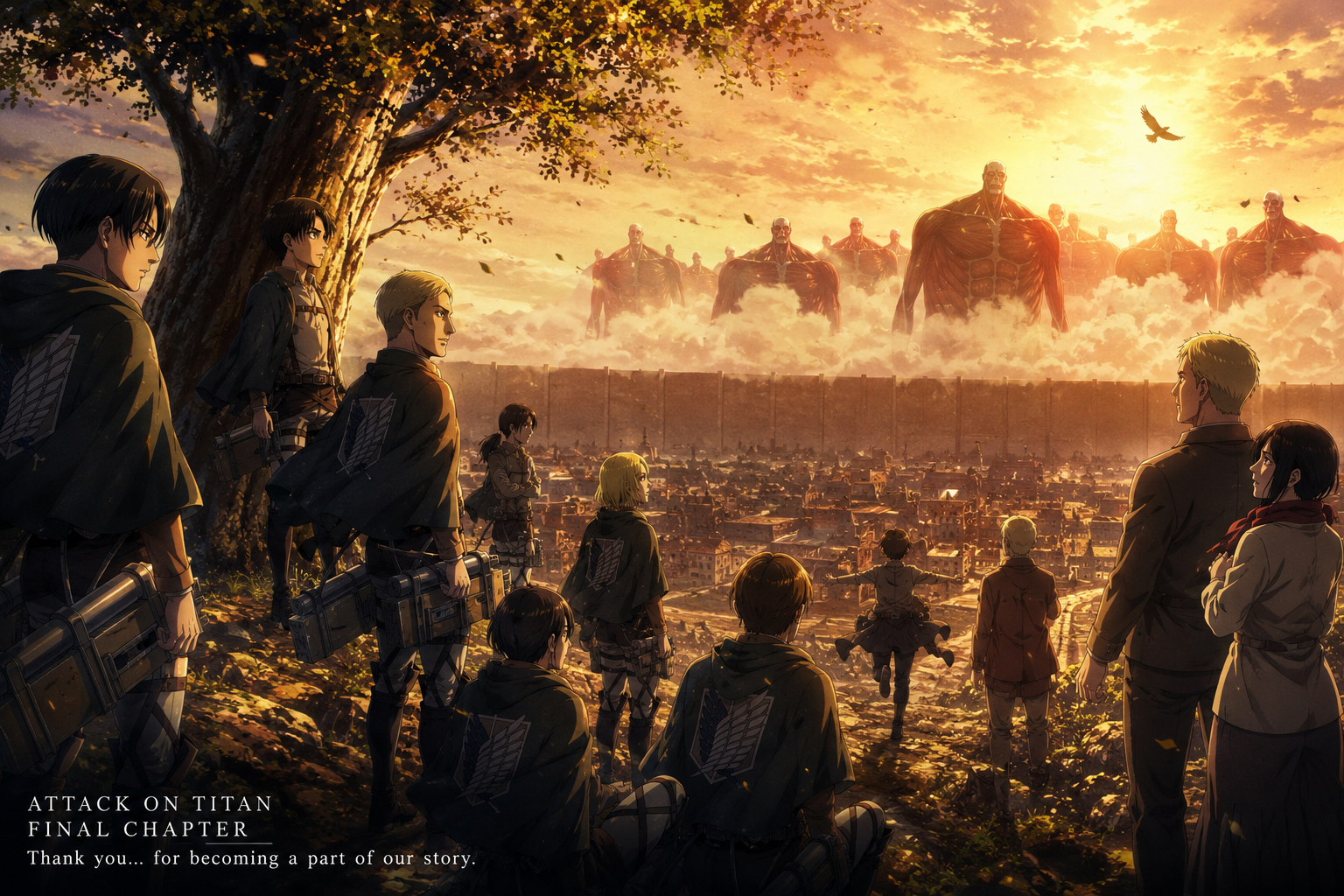
Attack on Titan: The Final Chapters - A Complete Breakdown
Eren Yeager enacted the Rumbling to achieve three objectives: destroy the world’s military forces, make his friends into heroes who would stop him, and end the Titan curse forever. He succeeded in all three, but the cost was 80% of humanity and his own life.
The final arc of Attack on Titan isn’t about victory. It’s about the terrifying mathematics of sacrifice—how many lives is freedom worth? Hajime Isayama spent eleven years constructing a narrative that systematically dismantles the concept of absolute morality, and the ending reflects that commitment. No character emerges clean. No ideology is validated without cost. The Rumbling, Eren’s transformation into a world-ending threat, and the final confrontation between former friends all serve a single purpose: forcing us to examine what we’re willing to sacrifice for the people we love.
The Rumbling: Understanding Isayama’s Grand Design
Why the Rumbling Happened
The Rumbling wasn’t Eren’s first choice. It wasn’t even his second. For three seasons, Eren pursued every alternative: negotiating with the outside world, trusting in the Alliance between Paradis and Marley, even attempting to use the Founding Titan’s power selectively. Each path failed because the world’s hatred for Eldians was absolute.
The Declaration of War (Season 4, Episode 5 / Chapter 100) was Eren’s breaking point. When Willy Tybur announced Paradis as the world’s enemy, Eren understood the truth: diplomacy was a fantasy. The international community would never accept Eldians. The only language they understood was force.
Isayama frames this brilliantly through Eren’s internal conflict. We see his memories of the future—fragments of what will happen if he doesn’t act. His mother’s death. Sasha’s death. Hange’s sacrifice. The images are hazy but undeniable. Eren isn’t making a choice based on emotion; he’s following a script he’s already read, desperately trying to find a better ending.
The Mechanics of the Rumbling
The Colossal Titans within the Walls—numbering in the hundreds of thousands—were created by Karl Fritz over a century before the series began. Each one stands approximately 60 meters tall, capable of releasing steam hot enough to boil oceans and step with enough force to register as seismic events across continents.
Key specifications from the official databooks:
- Total Count: Approximately 585,000 Colossal Titans
- Average Speed: 15-20 km/h on land, faster in water
- Heat Output: Steam temperature exceeding 800°C
- Stepping Force: Equivalent to magnitude 7+ earthquakes
- Activation Method: Founding Titan command via royal or high-Eldian blood
The titans moved in formation, flattening Marley’s military installations first, then moving outward in concentric circles. By the time Armin’s group reached Eren, the titans had already destroyed 80% of the world’s population centers (Episode 87 / Chapter 138).
The Environmental and Political Aftermath
The Rumbling didn’t just kill people—it destroyed civilization. Marley’s industrial infrastructure, the Middle East’s agricultural heartland, and the Eastern nations’ coastal cities were all reduced to rubble. Global temperatures dropped by an estimated 4°C due to the dust cloud. Famine, disease, and political collapse followed.
Isayama uses these details not for shock value but to reinforce a central theme: violence, even when justified, creates chaos that outlasts the initial conflict. Paradis survived, but at what cost? The world they wanted to join no longer exists. Eren’s “freedom” is a graveyard.
The Attack Titan’s True Power: Unraveling the Timeline Paradox
Future Memory Inheritance Explained
The Attack Titan’s ability to see future inheritors’ memories is the series’ most complex narrative device. Unlike other Titans, which only transmit past memories to shifters, the Attack Titan sends memories forward. This means Eren could see what future inheritors would witness—and more importantly, he could send memories back to influence past shifters like Grisha and Kruger.
Timeline Breakdown:
-
Eren kisses Historia’s hand (Chapter 90) and glimpses the future: the Rumbling, his friends’ reactions, and his own death.
-
Eren manipulates Grisha (Chapter 121) through future memories, convincing him to kill the Reiss family. Grisha sees the Rumbling’s horror but still passes the Attack Titan to Eren.
-
Eren sends memories to Kruger (Chapter 88) causing him to mention Mikasa and Armin, setting events in motion long before Eren’s birth.
-
Eren experiences past, present, and future simultaneously after touching Zeke (Chapter 120), understanding that his path was always predetermined—yet still his choice.
The Determinism Paradox
Eren’s ability to see the future raises a central philosophical question: If you know what will happen, do you truly have free will? Isayama’s answer is nuanced.
Eren could have chosen differently. He admits in Chapter 139 that he tried to find alternative paths. But every possibility led to the same outcome—the Rumbling, his death, and the Titan curse’s end. Determinism and free will coexist because Eren’s nature made other choices impossible. He is who he is: someone who would sacrifice everything for his ideal of freedom.
This isn’t a cop-out. It’s an acknowledgement that while we are products of our circumstances, our choices still define us. Eren chose the Rumbling because Eren would choose the Rumbling. His personality, shaped by trauma and experience, made that outcome inevitable.
The Warriors: Understanding Marley’s Perspective
Reiner Braun: The Tragic Parallel
Reiner’s arc in the final season mirrors Eren’s in heartbreaking ways. Both are child soldiers shaped by their environments. Both bear the weight of genocide. Both desperately want to be understood.
When Reiner confronts Eren in the Paths (Chapter 133), the conversation is one of mutual recognition. Reiner doesn’t condemn Eren because he understands the impulse to destroy everyone who threatens the people you love. He did the same thing as the Armored Titan, breaching Wall Maria and causing thousands of deaths.
Reiner’s survival and eventual peace represent a counterpoint to Eren’s fate. Reiner chooses to live with his guilt, to carry it as penance rather than let it consume him. Eren, by contrast, chooses a path that guarantees his own destruction while achieving his goals. Both are valid responses to trauma, but Reiner’s approach offers hope for healing.
Gabi Braun: The Cycle of Hatred Personified
Gabi’s role in the final arc is often underappreciated. She enters the story as a Marleyan patriot, believing Paradisians are devils. She kills Sasha, the fan-favorite, and fans hated her for it. That was Isayama’s intention.
Gabi’s journey from hatred to understanding mirrors the series’ entire thematic arc. Her friendship with Sasha’s family, her growing realization that Paradisians are people, not monsters, and her eventual fight alongside her former enemies—all of it demonstrates that breaking the cycle is possible.
Gabi’s character works because Isayama doesn’t let her off easily. She killed someone. She has to live with that. But she also grows, changes, and eventually plays a crucial role in stopping the Rumbling. The world needs people like Gabi—people who can unlearn hatred.
Annie Leonhart: The Survivor’s Guilt
Annie’s reemergence from her crystal cocoon (Chapter 126) is one of the series’ most emotionally charged moments. She spent four years frozen, disconnected from time, while her friends fought, died, and changed. When she finally emerges, the world is unrecognizable.
Annie’s arc is about confronting guilt. She committed atrocities as a Warrior—the same atrocities that Reiner and Bertholdt committed. But unlike them, Annie never fully believed in the Marleyan cause. She was following orders, trapped in a system she hated.
In the final battle, Annie chooses to fight for the world, not because she’s a hero but because she wants to protect her father. Her motivation is selfish, and that’s what makes it real. The final arc understands that people don’t need perfect motivations to do good things. Sometimes, love for a single person is enough.
The Final Battle: Strategy, Sacrifice, and Symbolism
The Alliance’s Formation
The formation of the Alliance—Eldians, Marleyans, and others fighting together—is Isayama’s clearest statement about breaking cycles. Characters who were mortal enemies now stand shoulder-to-shoulder: Jean and Pieck, Connie and Gabi, Levi and Zeke (briefly).
Key Alliance Members:
- Armin Arlert (Colossal Titan): Tactical commander
- Mikasa Ackerman (Ackerman combatant): Primary combatant
- Levi Ackerman (Ackerman combatant): Field commander
- Jean Kirstein (Human soldier): Heavy weapons
- Connie Springer (Human soldier): Support
- Reiner Braun (Armored Titan): Frontline defense
- Annie Leonhart (Female Titan): Fast attack
- Pieck Finger (Cart Titan): Logistics and support
- Falco Grice (Jaw Titan): Aerial assault
- Gabi Braun (Human soldier): Marksman support
The alliance represents what Eren couldn’t achieve: unity beyond hatred. They fight against the person they love most because they refuse to accept his solution. Their courage isn’t in their strength but in their willingness to oppose him.
Eren’s True Form: The Doomsday Titan
When Eren fully manifests the Founder’s power (Chapter 138), his titan form becomes something unprecedented. The Doomsday Titan—a skeletal creature so massive it defies comprehension—is fused with the Founding Titan, Attack Titan, War Hammer Titan, and Colossal Titan powers simultaneously.
Specifications from official materials:
- Height: Approximately 600 meters from chin to spine
- Length: Extended vertebrae reach over 1 kilometer
- Weight: Uncalculable—beyond the laws of physics
- Abilities: All nine titan powers, coordinate control, future memory manipulation
- Weakness: The connection between Eren’s human body and the titan form
The Doomsday Titan is visual symbolism for Eren’s transformation. He’s no longer human. He’s become an idea—a force of nature, terrible and awe-inspiring. But the human within remains, and that’s his vulnerability.
The Killing Blow: Mikasa’s Choice
Mikasa’s final kill is loaded with meaning. The series established early that Ackermans have innate combat abilities, but Mikasa’s strength was always protective. She fought to defend Eren. Killing him represents a complete inversion of that instinct.
The moment is structured with precision:
- Mikasa enters the Doomsday Titan’s mouth
- She sees Eren’s head attached to the spine
- Eren speaks to her one last time through memories
- She kisses him—their first and only kiss
- She severs his head, ending the curse
The kiss is the key. Ymir Fritz spent 2,000 years serving the royal bloodline, believing love meant obedience. Mikasa demonstrates the opposite: love can mean letting go. When she kills Eren, she frees Ymir too. The curse of titans ends because someone proved that love isn’t captivity.
Character Endings: The Weight of Survival
Eren Yeager: The Paradoxical Victim
Eren achieved everything he set out to do, but he also failed. He wanted his friends to live long lives. He wanted to see the world beyond the walls. He wanted to end the Titan curse.
What Eren accomplished:
- Destroys 80% of humanity, rendering the world unable to attack Paradis
- Creates the Alliance, uniting humanity against a common enemy
- Makes his friends heroes, ensuring Paradis’s survival
- Ends the Titan curse permanently
- Forces Ymir to break her 2,000-year servitude
What Eren lost:
- His own life
- His humanity
- His relationship with Mikasa and Armin
- His chance to see the world he fought for
- He becomes a murderer on a scale unimaginable
Eren’s final conversation with Armin (Chapter 139) reveals a broken young man. He admits he was an idiot who got too much power. He confesses his love for Mikasa, a feeling he repressed because it would complicate his mission. He apologizes for everything. But he doesn’t regret his choices because he believes they were necessary.
This honesty makes Eren’s death tragic but earned. He wasn’t a monster. He was a child forced into monstrosity by a world that offered no alternatives.
Armin Arlert: The Eternal Questioner
Armin survives the final battle and becomes the world’s hope for peace. He carries Eren’s legacy, his memory, his burden. The final panels show Armin visiting Eren’s grave, still wrestling with what happened, still searching for answers he’ll never find.
Armin’s significance:
- Represents the possibility of diplomacy and understanding
- His Colossal Titan form helped stop the Rumbling
- Becomes the leader of the peace negotiations
- Lives with survivor’s guilt, knowing he couldn’t save Eren
- Exemplifies the series’ insistence on continuing despite trauma
Mikasa Ackerman: The Wielder of Freedom
After Eren’s death, Mikasa lives a full life. She marries, has children, and raises a family. She visits Eren’s grave annually, always tying the scarf he gave her. In her old age (shown in the post-credits scene), she passes the scarf to her descendants.
Mikasa’s ending represents:
- Freedom achieved through letting go
- The possibility of healing after unimaginable pain
- Eren’s legacy living on through people who loved him
- Breaking the cycle of obsession
- Finding life after loss
Levi Ackerman: The Last Veteran
Levi’s fate is bittersweet. He’s crippled, blinded in one eye, and missing fingers. But he survives. In the final panels, he salutes the graves of his fallen comrades and smiles.
Levi’s legacy:
- Carries the memories of the Survey Corps
- Represents resilience in the face of endless loss
- Has his promise fulfilled—to see Eren’s vision through
- Finds purpose in mentoring the next generation
- His survival emphasizes the importance of witnesses to history
Historia Reiss: The Ambiguous Queen
Historia’s role in the final arc is the series’ most debated element. She becomes queen, gives birth to a child, and oversees Paradis’s reconstruction. However, the father of her child is never explicitly shown (the farmer from her childhood is implied).
The ambiguity is intentional. Isayama wanted to keep Historia’s fate open to interpretation. Was she manipulated by Eren? Did she have a choice? Is her child symbolic of Paradis’s future? The uncertainty reflects the series’ broader themes about information, trust, and the limitations of perspective.
Themes and Symbolism: Deconstructing Isayama’s Philosophy
Freedom and Its Costs
Freedom is the series’ central theme, but Isayama subverts it repeatedly. Characters fight for freedom, only to become prisoners of their choices. Eren’s quest for freedom results in the ultimate slavery—becoming an idea rather than a person.
Freedom is presented as:
- A goal worth dying for
- An illusion in a deterministic universe
- Something that requires sacrifice
- Never absolute—it always limits others
- Achievable only through understanding and forgiveness
The Cycle of Hatred
Isayama doesn’t offer easy solutions to the cycle of hatred. The characters who break it do so through individual choices, not systemic change. Gabi and Falco choose to see Paradisians as human. Reiner chooses to live with his guilt. Armin chooses diplomacy over revenge.
Breaking the cycle requires:
- Acknowledging shared humanity
- Confronting past atrocities honestly
- Choosing empathy over fear
- Accepting personal responsibility
But Isayama is realistic: the cycle never fully ends. The post-credits scene shows Paradis being bombed—centuries in the future—suggesting that peace is always temporary. The challenge is to make it last as long as possible.
The Nature of Monsters
The series continuously asks: Who are the real monsters? Titans, or the humans who create them? Marley, or the Eldian government that oppressed its own people? Eren, or the world that forced him into a corner?
Isayama’s answer is that monsters are made, not born. Circumstances create cruelty. Systems generate violence. The responsibility lies not in blaming individuals but in dismantling the structures that create suffering.
Memory and Identity
The Paths realm connects all Eldians through shared memory. This concept has profound implications for identity:
- We are shaped by those who came before us
- Trauma is inherited
- Forgiveness requires remembering
- Identity can be a burden or a gift
Ymir Fritz’s liberation comes when Mikasa shows her that memory isn’t destiny. You can honor the past without being enslaved by it. That’s the series’ most hopeful message.
The Post-Credits Scene: Isayama’s Bleak Warning
The Boy and the Tree
The final panels (Chapter 139) show a boy and a dog approaching a tree identical to the one Ymir Fritz found millennia ago. The implication is chilling: the cycle will repeat. Another child will discover a strange power. Another era of titans will begin.
The scene’s symbolism:
- History repeats when we forget it
- Human nature is unchanging
- Freedom is temporary
- The past can never be fully escaped
- Hope and despair coexist
Paradis’s Destruction
A later scene (the final pages of the volume edition) shows Paradis being bombed, civilization rebuilt, and eventually destroyed again. Isayama’s point is devastating: even paradise isn’t permanent. The survivors of the Rumbling are doomed to repeat the mistakes of their ancestors.
This isn’t nihilism—it’s realism. The series never promised a happy ending. It promised an honest one. And honestly, humanity’s track record shows that peace is fragile. The best we can do is make it last as long as possible.
What Comes Next
The final message isn’t hopeless. The boy finding the tree suggests curiosity and wonder—the same qualities that drove Eren to explore beyond the walls. The cycle might repeat, but it also might not. That ambiguity is Isayama’s gift to readers. He doesn’t tell us what to think. He asks us to keep thinking.
The Ending: A Comprehensive Analysis
What Worked
Thematic cohesion. The ending stays true to everything the series established. Violence has consequences. Freedom requires sacrifice. Love isn’t simple. There are no easy answers.
Character consistency. Eren’s choices, though horrifying, are in character. Mikasa’s final act is heartbreaking but inevitable. Armin’s survival represents hope.
Emotional impact. The final confrontation, Eren’s confession, Mikasa’s kiss—these moments land because they’re earned. The characters have been through so much, and their pain is palpable.
Ambiguity. Isayama respects readers enough to leave questions unanswered. We’re meant to discuss, debate, and reflect.
What Didn’t Work
Pacing. The final arc rushes through some plot points, particularly Historia’s role and the immediate aftermath of the Rumbling. More time with the characters in peace would have been welcome.
The Eren-Armin conversation. Some readers wanted more dialogue, more exploration of Eren’s state of mind. The conversation is powerful but brief.
Paradis’s post-Rumbling future. The ambiguity is intentional, but many fans wanted clearer answers about what happened to their favorite characters.
Ymir’s motivations. Her sudden liberation by Mikasa feels abrupt, though the thematic symmetry is undeniable.
The Verdict
Attack on Titan’s ending is a masterpiece of thematic writing with some structural flaws. It’s not perfect—no ending could satisfy everyone after eleven years of speculation. But it is true to itself. Isayama stayed committed to his vision, even when that vision was painful.
Rating: 9/10
- Thematic ambition: 10/10
- Character consistency: 9/10
- Emotional impact: 10/10
- Structural execution: 7/10
- Re-readability: 10/10
Frequently Asked Questions
Was Eren a hero or a villain?
Neither. He was a tragic figure shaped by circumstances beyond his control. He did monstrous things for what he believed were noble reasons. The series refuses to label him because that’s the point—absolute morality doesn’t exist.
Why did Eren let himself be killed?
Eren planned his own death. By becoming the ultimate villain, he made his friends into heroes. By dying, he ended the Titan curse. His death was always part of the plan.
What happened to Paradis after the ending?
The world’s peace with Paradis was fragile but initially held. Centuries later, Paradis was bombed and civilization collapsed. The cycle of history repeated itself.
Was the ending happy?
No. It was bittersweet, honest, and tragic. Happiness was never the goal—meaning was.
Is there going to be a sequel?
No, Isayama has confirmed the series is complete. The post-credits scene is thematic, not a teaser.
Final Thoughts: The Legacy of Attack on Titan
Attack on Titan isn’t just a story. It’s a cultural phenomenon that challenged anime’s conventions, pushed boundaries, and forced conversations about topics most series avoid. Isayama created a world where no one was safe, where heroism had a cost, and where even the most well-intentioned actions could spiral into atrocity.
The series’ legacy will be its refusal to compromise. It didn’t give fans what they wanted—it gave them what they needed: a story that respects their intelligence, challenges their assumptions, and forces them to confront uncomfortable truths about humanity.
What makes Attack on Titan enduring:
- Its willingness to explore gray morality
- Its refusal to take easy paths
- Its honest portrayal of trauma
- Its belief in character growth
- Its confidence in leaving questions unanswered
I started this series as a curious viewer, expecting monster battles and survival thrills. I finished it as someone fundamentally changed by its themes. The walls were always metaphorical. They represented everything we erect to protect ourselves from painful truths—prejudice, fear, denial. The Rumbling was our capacity for destruction. The ending was our hope for something better.
Attack on Titan won’t be forgotten. It’ll be studied, debated, and cherished. And its final message will linger: freedom is never free. But the struggle for it is what makes us human.
What do you think? Did Eren make the right choice? Is peace possible? Share your thoughts below—I’d love to continue this conversation.
About the Author
A passionate analyst of storytelling across all mediums, I’ve spent years dissecting the works that challenge, inspire, and transform us. Attack on Titan represents everything I love about fiction: its capacity to make us think, feel, and question. When I’m not writing, I’m watching, reading, or debating the stories that matter. Feel free to reach out—I’m always looking for fellow fans to discuss these ideas with.