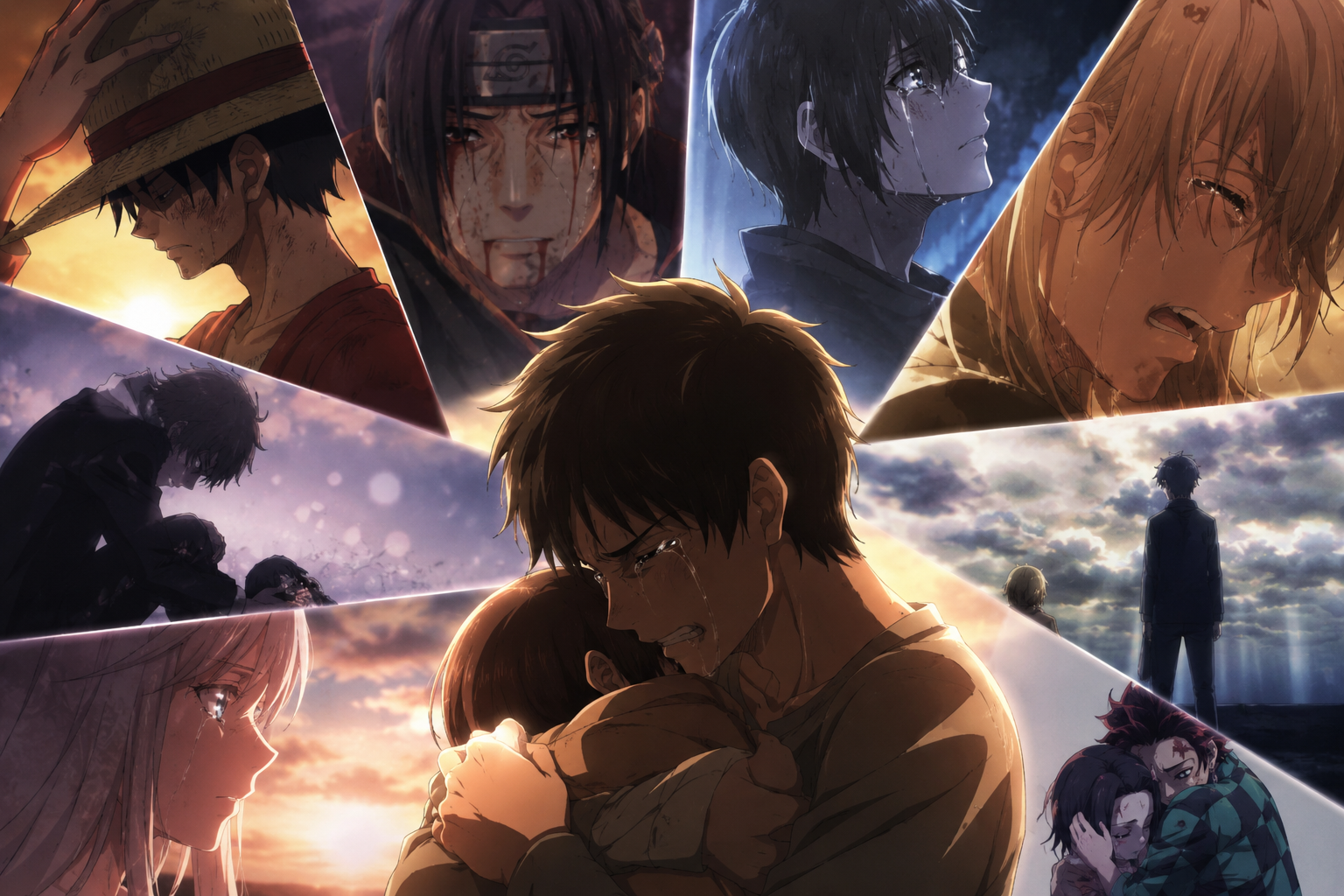
10 Anime Deaths That Broke the Internet: The Complete Breakdown
Kaori Miyazono’s death in Your Lie in April isn’t just the saddest anime death—it’s the most devastating because we watch it coming for the entire series. Her letter, her confession, her final gift to Kousei—it’s a tragedy that’s both beautiful and unbearable. When she says “I love you” through a piece of music, it’s too late. The words were always there. She just couldn’t say them.
There’s something uniquely painful about fictional death. We know these characters aren’t real. We know their stories are scripted. And yet, when they die, something in us breaks. It’s not just the loss of a character—it’s the loss of everything they represented. Their dreams. Their relationships. Their future.
These aren’t just plot points. They’re reminders of our own mortality, of the fragility of connection, of the terrible beauty of loving something that can be taken away. Some deaths are heroic. Some are senseless. Some are beautifully tragic. All of them changed the anime landscape forever.
Let’s break down the ten anime deaths that shattered the internet.
#10 - Maes Hughes (Fullmetal Alchemist: Brotherhood)
“It’s a terrible day for rain.”
Maes Hughes was the emotional heart of Fullmetal Alchemist. The lovable family man who couldn’t stop talking about his daughter Elicia. The enthusiastic friend who supported Roy Mustang unconditionally. The kind of person who made the world feel brighter simply by existing in it.
His death is calculated cruelty. There’s no epic battle. No heroic sacrifice. Hughes is simply killed because he discovered too much—a victim of the conspiracy he was trying to unravel. The mundanity of it, the senselessness, makes it infinitely more devastating.
The Funeral Scene:
The funeral is where the emotional damage truly lands. Elicia, too young to understand death, asks why they’re burying her father. She says the workers are being mean for putting him in the ground. It’s emotional manipulation at its finest, and it works perfectly.
Roy Mustang’s grief is equally devastating. He can’t cry at the funeral. He has to remain composed, to honor his friend’s memory with dignity. But later, alone in the rain, he breaks down completely. The rain hides his tears. The audience feels every single one.
Why It Works:
Hughes was innocent. He was good. He was a father who just wanted to show off pictures of his daughter. He didn’t deserve it. And in a series filled with moral complexity, his death serves as a reminder that some things are simply, irrevocably unfair.
The Legacy:
Hughes’s death fuels Mustang’s entire character arc. It’s the reason he becomes so determined to uncover the truth. And it’s the reason his final confrontation with Envy is so emotionally charged. Revenge isn’t justice, but sometimes it’s all we have.
#9 - Jiraiya (Naruto Shippuden)
“The final chapter… I’ll leave it to you, Naruto.”
Jiraiya’s death is a masterclass in tragic fulfillment. The man who was always a little too pervy, a little too carefree, a little too willing to laugh at his own failures—he goes out as a hero, facing Pain alone, knowing he won’t survive but fighting anyway.
The battle against Pain is spectacular. Jiraiya uses everything he’s learned, every technique he’s mastered, and still comes up short. But it’s not the battle that destroys us—it’s the final moments.
The Final Thoughts:
Jiraiya, bleeding out, thinking of Naruto. Of the boy he trained. The boy who became his grandchild in spirit. His final thoughts are all about passing the torch. He was never the strongest, never the most successful, but he was the one who believed in Naruto when no one else did.
The Popsicle Scene:
And then there’s Naruto’s reaction. The popsicle scene is one of the quietest, most devastating moments in anime. Naruto sits alone, buying two popsicles, unable to eat the second one because it’s too painful to remember that Jiraiya is gone.
He mourns alone. He can’t even share his grief with anyone because he has to keep moving forward. He has to become Hokage. He has to protect the village. But in that moment, he’s just a broken kid who lost his grandfather.
Why It Works:
We watched Naruto lose his father figure—again. After finally connecting with Jiraiya, after finally understanding what it meant to have a mentor, he was taken away. The tragedy is compounded by Naruto’s growth: he can’t even mourn properly because he has to keep moving forward.
The Legacy:
Jiraiya’s death defines Naruto’s entire journey. His philosophy—the belief that people can understand each other—becomes Naruto’s guiding principle. The Pervy Sage lives on in his student’s actions.
#8 - Lelouch vi Britannia (Code Geass)
“I… I destroy the world… and create it… anew.”
Lelouch’s death is the most calculated on this list. The Zero Requiem was his plan from the very beginning: become the world’s villain, unite humanity against a common enemy, and die at the hands of his best friend so that the world could move forward.
It’s brilliant. It’s ruthless. It’s heartbreaking.
The Zero Requiem:
Lelouch’s plan is a masterpiece of strategic thinking. He doesn’t just want to defeat his enemies—he wants to create lasting peace. By becoming the world’s most hated figure, he gives humanity a common enemy to unite against. By dying, he ensures that unity lasts.
The Final Scene:
The final scene is devastating. Nunnally, touching her brother’s hand, finally understands the truth. She realizes he was protecting her all along. She realizes he sacrificed everything—his happiness, his reputation, his life—for her future.
But it’s too late. He’s already gone.
Suzaku, the man who killed him, must live with the knowledge that he murdered his best friend for the greater good. The burden of the Zero Requiem will haunt him forever.
Why It Works:
Lelouch succeeds in his goal. He creates a better world. But the cost is everything. His happiness. His reputation. His life. The tragedy is perfect: a hero who becomes a villain, a villain who was always a hero, and an ending that’s both triumphant and unbearably sad.
The Legacy:
Lelouch’s death redefined what anime endings could be. It proved that heroes don’t always survive. That victory can come at an unbearable cost. That sometimes, the greatest sacrifice is a life lived in service of others.
#7 - Portgas D. Ace (One Piece)
“I’ve lived my life with no regrets.”
Ace’s death is the moment One Piece stopped being a simple adventure and became something far more complex. The Whitebeard War, already brutal and emotionally charged, reaches its devastating climax when Ace dies protecting his little brother.
The Backstory:
Ace’s character is defined by self-doubt. He feared he didn’t deserve to exist. He desperately needed to prove himself worthy of being Gol D. Roger’s son. His journey was about finding purpose, understanding that he was loved, accepting that he didn’t need to earn his existence.
The Final Moment:
And then, in his final moment, he finally understands. He tells Luffy he has no regrets. He tells him he loves him. He thanks him for everything. It’s the emotional release Ace never allowed himself to experience—and it comes at the very instant of his death.
The Aftermath:
Luffy’s breakdown is one of the most raw and painful scenes in anime history. His screams, his desperate attempts to save his brother, his complete emotional collapse—it’s devastating to watch.
Jimbei’s words cut through the grief: “Don’t lose sight of what you still have. You still have your friends.”
Why It Works:
Luffy’s trauma is the real tragedy. Ace was freed. He was safe. And then he was gone. It’s a reminder that in One Piece, even the most hard-won victories can be snatched away in an instant.
The Legacy:
Ace’s death defines Luffy’s entire post-timeskip journey. It’s the reason he becomes more serious, more focused, more determined to protect his crew. The loss of his brother taught him that freedom has a cost.
#6 - Kamina (Gurren Lagann)
“Later, buddy.”
Kamina is the hype man to end all hype men. Loud, confident, absurdly optimistic, he seemed invincible. Which is exactly why his death in episode 8 comes as such a devastating shock.
The Battle:
The battle against the Gunmen is going well. Kamina is in his element, charging forward, believing in the impossible. And then, suddenly, he’s mortally wounded. The momentum is shattered. The show’s heart stops beating.
The Final Words:
His final words to Simon—“Later, buddy”—are a gut-punch. He doesn’t say goodbye. He says “later,” as if they’ll meet again, as if death isn’t the final word. It’s classic Kamina, refusing to acknowledge the gravity of his own situation, even as his life fades away.
The Aftermath:
Simon’s despair is the true tragedy. Without his brother’s constant encouragement, he’s lost. His painful journey toward becoming the man Kamina believed he could be defines the rest of the series.
Why It Works:
Kamina’s death isn’t just a loss—it’s a challenge. The show forces Simon—and us—to carry on without him. His energy, his confidence, his absolute refusal to give up—it all vanishes, and we have to learn to live without it.
The Legacy:
Kamina’s philosophy—“Believe in the me that believes in you”—becomes Simon’s guiding principle. The man who seemed invincible becomes immortal through his student’s actions.
#5 - Nicholas D. Wolfwood (Trigun)
“Now I know… I was just a selfish guy who wanted to live.”
Nicholas D. Wolfwood is the definition of a tragic character. Raised to be a killer. Believed he was beyond redemption. Used his faith as a weapon rather than a comfort. And yet, through Vash’s influence, he slowly began to believe he might be worth saving.
The Final Battle:
His final battle is brutal. Wolfwood, already weakened, fights against impossible odds. He knows he’s going to die. But he keeps fighting anyway—for Vash, for the future, for the possibility that his death might mean something.
The Final Cigarette:
The final cigarette. The conversation with Vash. The smile of relief on Wolfwood’s face as he dies, knowing he was loved, knowing his life had meaning. It’s a quiet death, a peaceful death, and it’s absolutely devastating.
The Confession:
His final words—“Now I know… I was just a selfish guy who wanted to live”—are heartbreaking because they’re true. He wasn’t selfish at all. He was just a man who wanted to believe he deserved happiness.
Why It Works:
Vash’s reaction is the real tragedy. The realization that Wolfwood, who spent his entire life believing he was a monster, died knowing he was so much more. It’s a quiet, peaceful death that somehow hurts more than the epic ones.
The Legacy:
Wolfwood’s death deepens Vash’s pacifist philosophy. It proves that even the most broken people can find redemption—and that sometimes, the greatest gift is simply being loved.
#4 - Nagisa Furukawa (Clannad: After Story)
“I’m glad… I met you…”
Clannad: After Story is an emotional minefield, and Nagisa’s death is the moment everything explodes. After watching Tomoya and Nagisa fall in love, get married, and build a life together, we’re finally given hope. And then Nagisa dies during childbirth.
The Cruelty:
The cruelty of it is almost unbearable. Tomoya has finally found happiness. He’s finally escaped the shadow of his own broken family. And then the universe takes it all away. His grief is paralyzing, and we feel every moment of it.
The Aftermath:
But then there’s Ushio. The daughter Nagisa left behind. Tomoya’s journey toward being a father, toward accepting his love for his child despite the pain, is one of the most beautiful arcs in anime.
The Double Tragedy:
And then… Ushio dies too. The show does it again. It’s devastating. The double tragedy—losing both his wife and his daughter—pushed Tomoya to the brink of complete emotional collapse.
Why It Works:
The entire Clannad fandom needed therapy after After Story. Nagisa’s death is tragic enough, but the way it affects Tomoya, the way it forces him to confront his own pain, is what makes it truly devastating.
The Legacy:
Nagisa’s death is a reminder that happiness is fragile, that love comes with risk, and that the people we care about can be taken from us at any moment. It’s one of the most honest depictions of grief in anime.
#3 - Kyojuro Rengoku (Demon Slayer)
“Set your heart ablaze.”
Rengoku only appeared in one movie—and yet he became a fan favorite instantly. His charisma, his unwavering optimism, his absolute refusal to give up—he was the kind of hero we all wanted to be.
The Battle Against Akaza:
His death against Akaza is the most heroic on this list. He could have survived. He could have escaped. But he chose to stay, to fight, to protect the people he cared about. Even as Akaza tried to escape, Rengoku held him back, smiling, telling everyone to live well.
The Final Moments:
And then he died. Sitting in the sun, smiling, at peace with his choices. It’s a death that’s tragic but not dark—a death that’s about legacy and hope rather than loss and despair.
The Impact:
The internet broke when Demon Slayer: Mugen Train was released. The memes came later, but the pain was real. Rengoku’s death inspired a generation of fans to “set their hearts ablaze”—to live with purpose, to fight for what matters, to never give up.
Why It Works:
He could have survived. He chose to protect everyone instead. His final words—“Set your heart ablaze”—are a challenge to everyone who watched. And the tragedy is that he’ll never see the world he helped protect.
The Legacy:
Rengoku’s death defines the entire Demon Slayer series. His philosophy—that the strong must protect the weak—becomes Tanjiro’s guiding principle. The flame Hashira may be gone, but his fire lives on.
#2 - Itachi Uchiha (Naruto Shippuden)
“I’m sorry, Sasuke. There won’t be a next time.”
Itachi’s death is a tragedy that took years to fully understand. For most of Naruto, he was the villain—the man who killed his clan, who tortured his brother, who seemed to exist only to make Sasuke suffer.
The Truth:
And then we learned the truth. Itachi didn’t kill his clan out of malice. He did it to protect the village, to prevent a coup that would have led to civil war. He did it for Sasuke—to give his little brother a chance to live in peace. His suffering was a burden he carried alone, for years, without complaint.
The Final Forehead Tap:
His death at Sasuke’s hands is the culmination of this tragedy. Itachi, dying, reaches out to Sasuke—not to attack, but to offer comfort. His final forehead tap, his final “I’m sorry”—it’s the most heartbreaking moment in the series.
The Aftermath:
Sasuke’s reaction is even more devastating. He spent his entire life hating Itachi, wanting revenge, believing that killing his brother would give him peace. And then he learns the truth, and he realizes that his brother loved him all along. It’s too late. The damage is done.
Why It Works:
Itachi suffered in silence for years to protect Sasuke’s future. His entire life was defined by a choice he made as a teenager—a choice that destroyed him and saved everyone else.
The Legacy:
Itachi’s death defines Sasuke’s entire post-timeskip journey. It’s the reason he seeks vengeance against Konoha, the reason he eventually finds redemption, and the reason he finally understands what it means to be a brother.
#1 - Kaori Miyazono (Your Lie in April)
“I love you.”
Kaori’s death is the most devastating on this list because it’s foreshadowed from the very beginning. We know she’s dying. Her illness is revealed early, and we spend the entire series watching her wither away—but also watching her live with a ferocity that defies her fate.
The Letter:
The letter at the end is the emotional climax. Kaori confesses everything—her love for Kousei, the lie she told about liking his best friend, the truth that she was dying all along. It’s a confession that comes too late, a love that never had the chance to bloom.
The Music:
But what makes her death so devastating is the music. Kaori’s final performance, her final gift to Kousei, is a reminder that art can transcend death. She lives on in his playing, in his memories, in the spring that they shared together.
The Final Scene:
The final scene, with Kousei reading the letter, learning the truth, breaking down in tears—it’s one of the most emotionally devastating moments in anime history.
Why It Works:
The classical music. The spring setting. The tragedy of young love, cut short by fate. Kaori’s death is a reminder that time is finite, that love is fragile, and that we should never wait to say the things that matter.
The Legacy:
Kaori’s death redefined romance anime. It proved that love doesn’t have to be forever to be meaningful. That sometimes, the briefest connections leave the deepest marks. And that even in death, love can transcend.
Honorable Mentions
Koro-sensei (Assassination Classroom)
A teacher who became a father figure to an entire class, choosing to die so they could live. His final roll call, calling out each student’s name one last time, is devastating. He gave them everything—including the freedom to kill him.
L (Death Note)
The world’s greatest detective, killed by the very man he was hunting. L’s death was shocking because he seemed untouchable. His defeat was a victory for Light—but a loss for justice.
Neji Hyuga (Naruto)
A genius who died protecting his friends, finally free from the curse of his birth. Neji’s death was a reminder that fate doesn’t have to define us. He chose his own path—and paid the price.
Sasha Blouse (Attack on Titan)
The potato girl who never stopped believing in freedom. Sasha’s death was senseless, sudden, and heartbreaking. She deserved more. We all know it.
Spike Spiegel (Cowboy Bebop)
A bounty hunter who finally found what he was looking for. Spike’s ambiguous death is haunting. Did he die? Did he survive? We’ll never know. And that’s the point.
Kaito (Kuroko no Basket)
The mentor who never got to see his students’ success. Kaito’s death is a reminder that the people who shape us often leave before we can thank them.
What Makes a Death “Break the Internet”?
Great fictional deaths share certain qualities:
Emotional Investment: We’ve spent time with these characters. We’ve grown to love them. Their deaths hurt because we care.
Narrative Significance: These deaths aren’t just shock value—they change the story. They define arcs. They motivate characters.
Thematic Resonance: Great deaths mean something. They’re not random. They serve the story’s themes and messages.
Aftermath: How the characters react to death is just as important as the death itself. Grief is the real story.
Legacy: The best deaths live on. The characters who die become immortal through the impact they leave behind.
Why These Deaths Still Hurt
Grief in fiction is a strange thing. We know these characters aren’t real. We know their deaths are scripted, planned, executed by writers who want to evoke a specific emotional response. And yet, when we see them die, we mourn them as if they were real.
That’s the power of great storytelling. It makes us care. It makes us feel. It reminds us that emotion, love, and loss are universal—that even in fiction, we can experience something real.
Why we can’t let go:
- They represented something. Hope. Love. Sacrifice. They embodied ideals we admire.
- Their stories were unfinished. They had dreams. Plans. Futures. Death took that away.
- We saw ourselves in them. Their struggles were our struggles. Their deaths felt personal.
- They reminded us of our own mortality. None of us are guaranteed tomorrow. These deaths are a warning.
Final Thoughts
These ten deaths changed anime forever. They broke our hearts, made us cry, and left us grieving for characters who never existed. But they also taught us something—about love, sacrifice, and the beauty of fleeting moments.
Grief is part of the human experience. It connects us. It reminds us that we care. And when we share that grief—even for fictional characters—we’re sharing something real.
Which death hit you the hardest? Did we miss any soul-crushing moments? Let me know in the comments. I’d love to hear your stories—the moments that broke you, the characters you still miss, the grief that lingers long after the credits roll.
About the Author
A believer in the power of emotional storytelling, I’ve always been drawn to narratives that explore the full spectrum of human feeling. Tragedy, love, loss, hope—these are the themes that resonate with me, that remind me what it means to be human. If you’ve made it this far, thank you for sharing this journey with me. Let’s remember the characters we’ve lost—and the stories that made us love them.